
Defect-Controlled MOF Mechanics
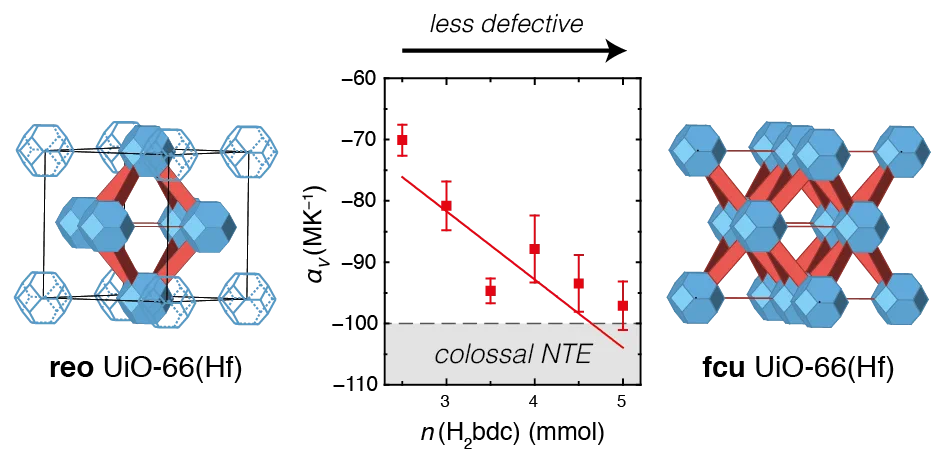 In our previous work we discovered that UiO-66, one of the canonical metal-organic frameworks (MOFs), can contain correlated defects, and showed that we have a degree of synthetic control over the presence and distribution of defects.
In this paper we use this control over defects to tune the physical properties of UiO-66. In particular, we look at the thermomechanical properties of UiO-66 – its response to changing temperature – and examine how they change with different concentrations of defects. We also show that the behaviour of UiO-66 on heating is pretty unusual. First, it rapidly densifies when heated to about 300 °C (as loosely bound molecules are driven off). Second, this densified material exhibits ‘colossal’ isotropic negative thermal expansion – i.e. when heated it shrinks in every direction.
We measured these thermomechanical properties by carrying out variable-temperature powder X-ray diffraction measurements at the Diamond Light Source, which allowed us to very precisely measure the size of the unit cell.
A short summary was published on the Chemistry World blog.
Paper
Defect-dependent colossal negative thermal expansion in UiO-66(Hf) metal–organic framework
M J Cliffe, J A Hill, C A Murray, F-X Coudert and A L Goodwin, Phys. Chem. Chem. Phys., 17, 11586–11592 (2015).
This article is also available on the arXiv.