Discovering New Polar Thiocyanate Perovskites
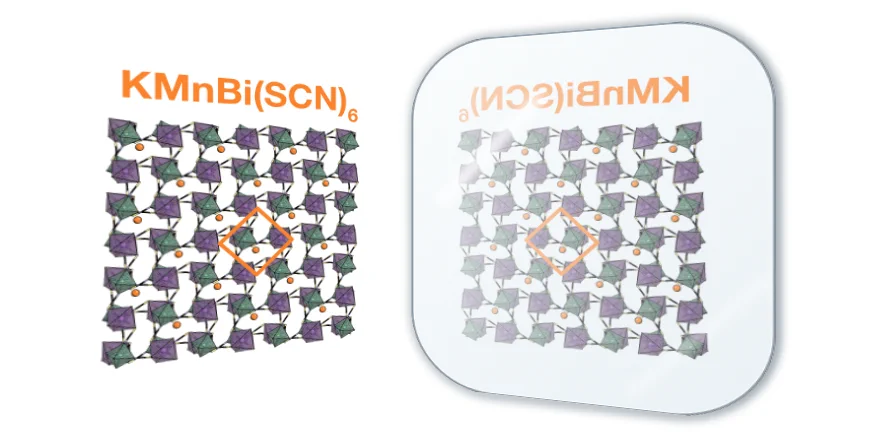 Figure: Structure of KMnBi(SCN)6 (and mirrored, which flips the polar axis).
Most crystals look the same in the mirror. This means they don’t know up from down: they are non-polar. Polar crystals, where there is a distinct directionality, have a range of very useful functional properties, including piezoelectricity, where pressure can produce an electric charge on the crystal faces, and second harmonic generation, where light can be doubled in frequency by passing through the crystal. Making new polar crystals is generally challenging. Some of the most important polar materials are perovskites, structures built from corner-sharing octahedra with charge-balancing ions in the open cages of the framework.
In this paper, Geers et al. synthesise four new materials based on the molecular ligand thiocyanate that have perovskite-type structures. The structures that are produced are surprisingly complex, due to a combination of unusual cooperative tilts of the octahedra and the pattern of ions amongst the cages. This combination of orderings produces the polarity. Solving the structure required a lot of different techniques, including electron, X-ray and neutron diffraction and solid-state nuclear magnetic resonance spectroscopy. This work shows that thiocyanate perovskites can be polar, opening the way to discovering a range of functional properties in this growing class of materials.
This work was a collaboration between the FIHM Group (spanning its move from Nottingham to Cambridge), with Dr Maddie Geers leading the project; scientists at the Institut Laue-Langevin, where Maddie was a PhD student; and the Kubicki Group at the University of Birmingham, with NMR collaborators at the Universities of Liverpool and Orléans and the University of Warwick.
Paper
Noncentrosymmetric Manganese Bismuth Thiocyanate Perovskites
M Geers, D J Kubicki, S P Argent, J P Tidey, E Salager, B B Duff, O Fabelo, L Cañadillas-Delgado and M J Cliffe, Chem. Mater., 38, 10805–10816 (2026).
This publication is open access with a CC-BY licence. In addition, the submitted version is available on the ChemRxiv.