
Flexibility in a Ferroelastic MOF
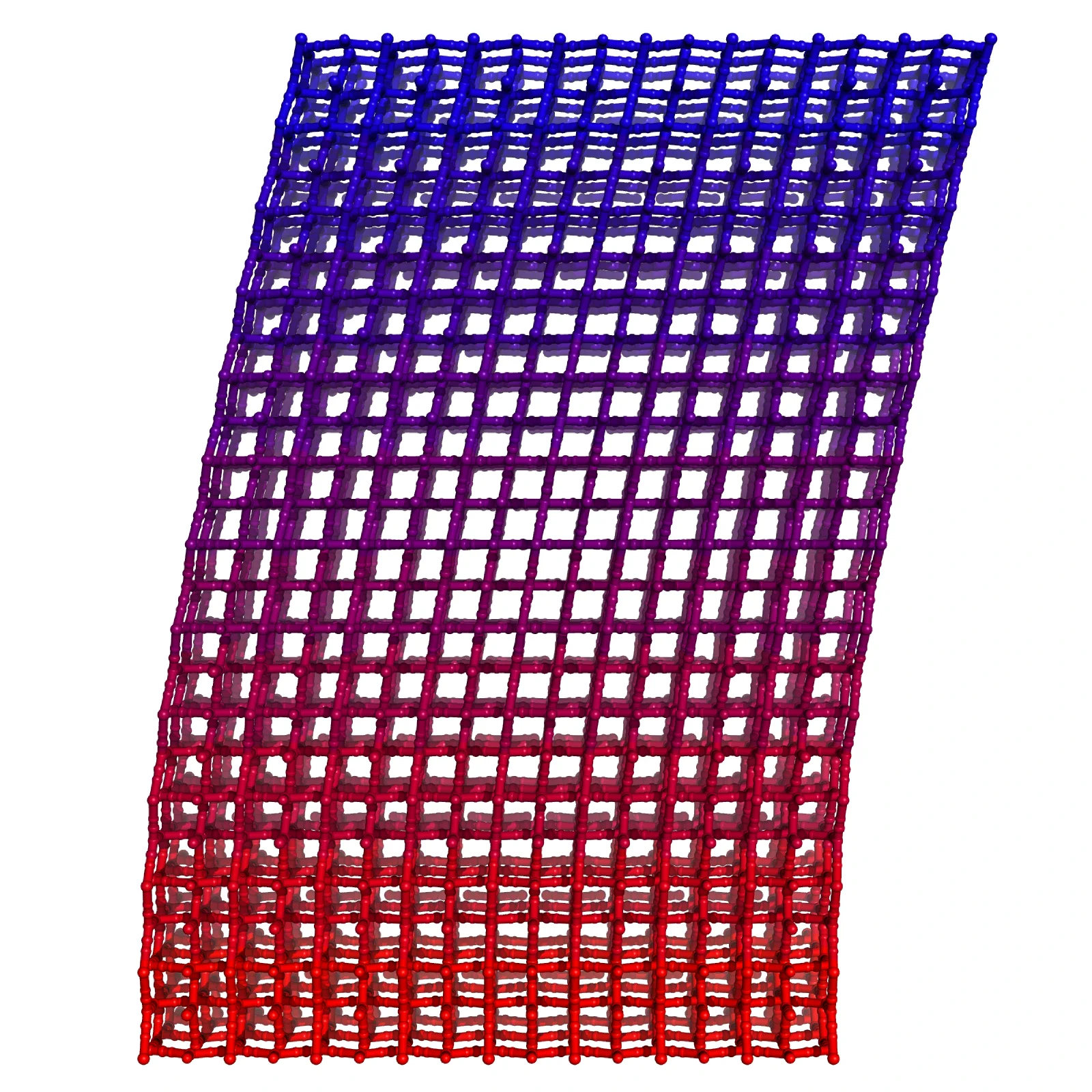 One of the most exciting features of metal-organic frameworks (MOFs) is their potential to be incredibly flexible.
In this paper we report a new MOF, copper(I) tricyanomethanide, Cu(tcm), which illustrates this very well.
Cu(tcm) undergoes a ferroelastic phase transition at Tf = 240 K and below this temperature shows thermal expansion an order of magnitude larger than above the transition.
In fact, the low-temperature phase α-Cu(tcm) shows ‘colossal’ positive and negative thermal expansion that is the strongest ever reported for a framework material.
We also found that Cu(tcm) can be converted just by exposure to gaseous acetonitrile to another new phase (acetonitrilo-copper(I) tricyanomethanide), and that this reaction can be reversed by putting copper tricyanomethanide under vacuum.
Infrared spectroscopy measurements are sensitive to the phase change, suggesting that Cu(tcm) might find application in solid-phase acetonitrile sensing.
Paper
Flexibility transition and guest-driven reconstruction in a ferroelastic metal–organic framework
S J Hunt, M J Cliffe, J A Hill, A B Cairns, N P Funnell and A L Goodwin, CrystEngComm, 17, 361–369 (2015).
This article is published under a CC-BY licence and is available free of charge via the RSC.