
Remixing 2D Magnets
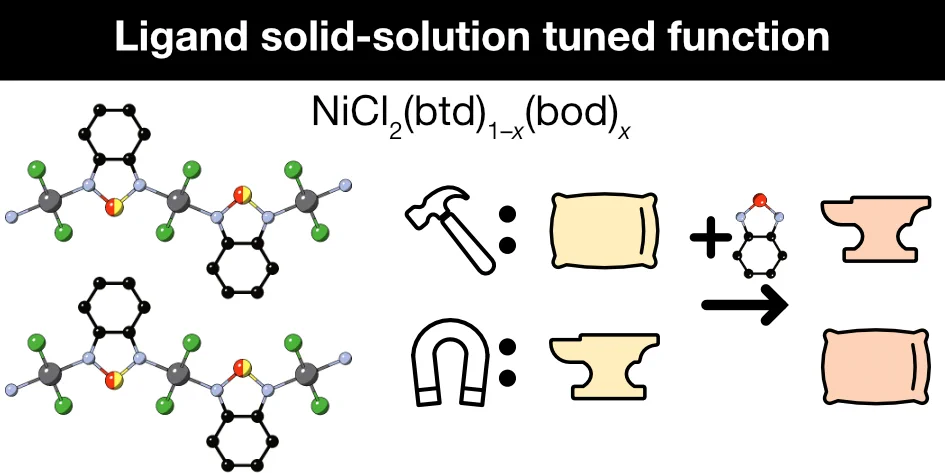
One of the key attractions of metal-organic materials is their variety: organic molecules can be tweaked and refashioned almost indefinitely. We have recently reported a new ‘crinkly magnet’, nickel dichloride 2,1,3-benzothiadiazole (btd), with an unusual ‘non-collinear’ magnetic structure. In this paper we explore what happens when the sulfur atom in btd is swapped for an oxygen atom.
We use high-pressure measurements to show that oxygen makes the metal-organic magnet slightly stiffer, but this stiffness changes more in some directions than others. We also find that oxygen makes the magnet ‘softer’ – that is, the magnetic domains become significantly easier to switch. This paper is one of the first demonstrations that the modular, Lego-like nature of MOFs can also be used to fine-tune their magnetic and mechanical properties.
This work was a collaboration with the Technical University of Munich and the Diamond Light Source (high-pressure studies), and the national electron diffraction facility at the University of Warwick. Emily Myatt, the first author, carried out this work as a master’s student in the group.
Paper
E Myatt, S Lata, J Pitcairn, D Daisenberger, S M Kronawitter, S A Hallweger, G Kieslich, S P Argent, J P Tidey and M J Cliffe, Chem. Commun., 60, 14427–14430 (2024).
This publication is open access with a CC-BY licence. In addition, the submitted version is available on the ChemRxiv.